Role Profiling
A role profile says what a job actually consists of — its responsibilities, the skills it draws on and what doing it well looks like — rather than what a job title implies.
Role & Skills Intelligence
Understand the work before planning the workforce. We help organisations define roles, identify essential skills and establish clear proficiency standards so that talent decisions reflect what successful performance actually requires.

What we do
A role profile says what a job actually consists of — its responsibilities, the skills it draws on and what doing it well looks like — rather than what a job title implies.
A framework is the shared vocabulary an organisation uses to talk about capability. Without one, every manager describes the same skill differently and none of the descriptions can be compared.
Naming a skill is not enough to act on: what matters is how much of it a role requires. Proficiency levels put a standard against each skill so that “can do” has a definition.
Mapping sets the skills an organisation has against the skills its roles require, and shows where the two do not meet.
Not every role carries the same risk. Critical-role work identifies the positions where a vacancy or a capability gap would be felt hardest, so planning attention goes where it counts.
A capability profile describes one person against the same framework the roles use — which is what makes a person and a role comparable at all.
Read together, individual profiles show what an organisation can currently do as a whole, and where its capability is thin.
In the product
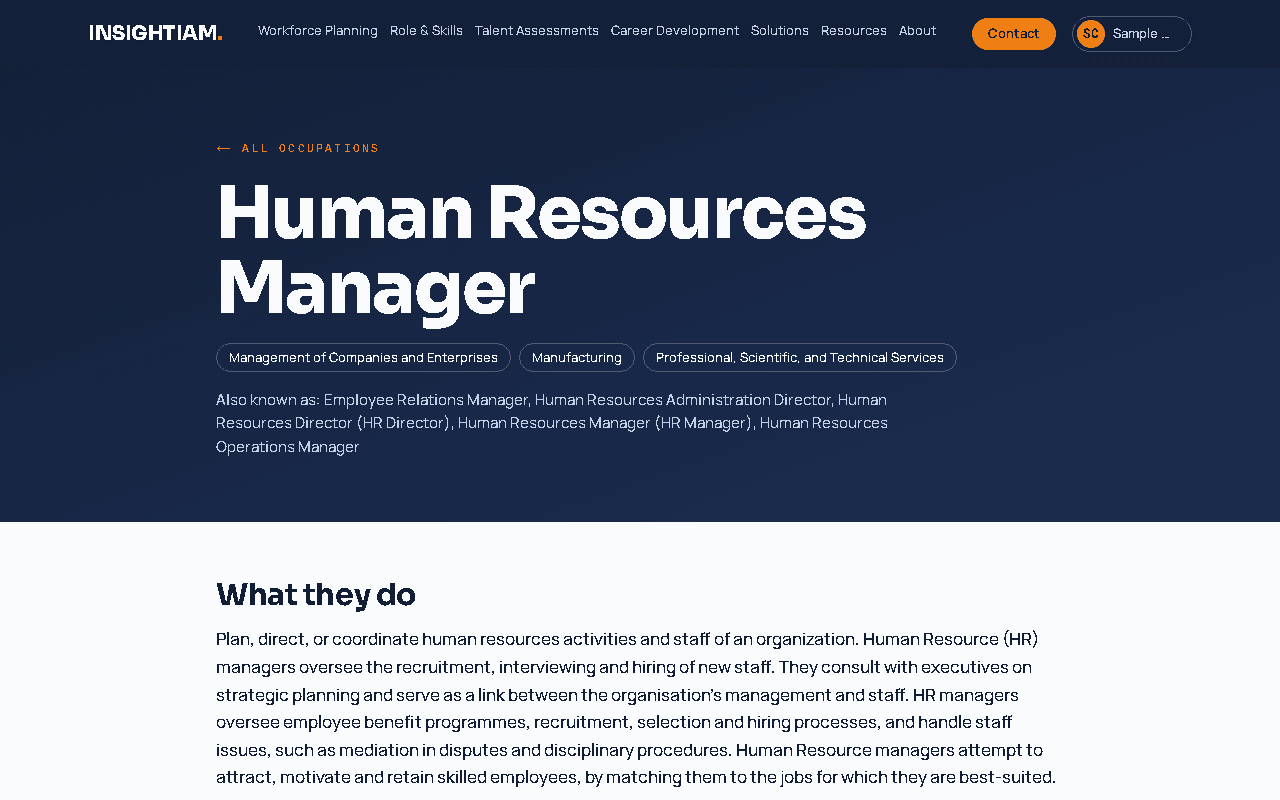
Signing in opens the full set, with the skills, abilities and work styles each occupation calls on.

The data behind it
The occupation profiles behind Role Profiling and Skills Mapping cover more than a thousand occupations, each described by the skills, abilities and work styles it calls on.
Tell us which roles are hardest to fill or hardest to describe, and we will start there.